
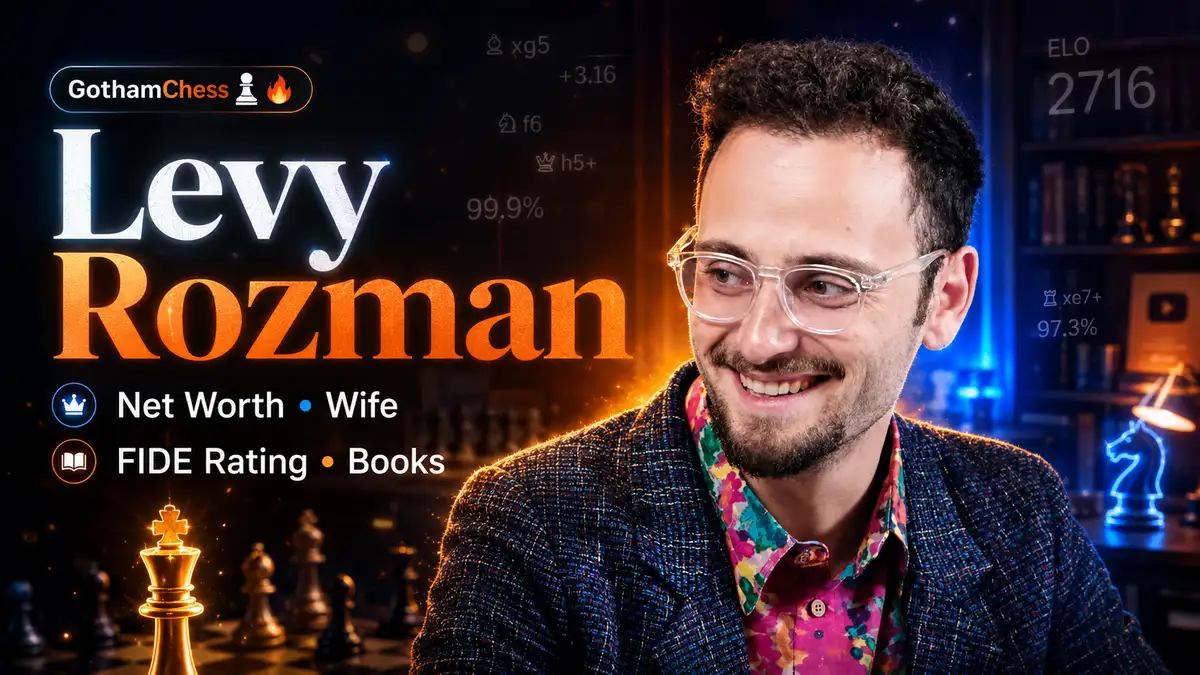
Levy Rozman, popularly known by his online alias GothamChess, is an American International Master (IM), chess educator, bestselling author, entrepreneur, YouTuber, and Twitch streamer. Widely regarded as one of the most influential figures in modern chess, he has transformed how millions of people learn and enjoy the game through engaging educational content and entertaining commentary.
Unlike many professional chess players who focus primarily on tournaments, Levy has built a global brand around teaching chess in a way that is accessible, practical, and enjoyable. His videos simplify complex chess ideas into lessons that beginners can understand while still providing valuable insights for experienced players.
Over the past decade, GothamChess has grown into the largest chess-focused YouTube channel in the world. His influence extends beyond YouTube to Twitch, books, online courses, live events, podcasts, and collaborations with some of the biggest names in chess.
From his early days as a talented junior player in New York to becoming one of the most recognizable ambassadors of chess worldwide, Levy Rozman’s journey is a remarkable example of how passion, consistency, and innovation can reshape an entire industry.
Levy Rozman (GothamChess) – Quick Information Table (2026)

| Attribute | Details |
|---|---|
| Real Name | Levy Rozman |
| Online Name | GothamChess / Gotham |
| Born | December 5, 1995 (Age 30) |
| Nationality | American |
| FIDE Title | International Master (IM) |
| Current FIDE Rating | 2318 (as of February 2026) |
| Peak FIDE Rating | 2421 (2018) |
| Wife | Lucy Rozman (married 2021) |
| YouTube Channel | GothamChess (Millions of subscribers) |
| Occupation | Chess Streamer, Content Creator, Author, Coach |
| Popular Books | How to Win at Chess, Chess for Babies, The Chess Deck |
| Net Worth (Est.) | Multi-million dollars (primarily from YouTube, Chessly, books & sponsorships) |
| Known For | Making chess fun and accessible for beginners and intermediates |
Early Life and Childhood
Levy Rozman was born on December 5, 1995, in Brooklyn, New York, where he spent most of his childhood. Although he was born in the United States, his family’s roots trace back to Eastern Europe.
His mother immigrated from Russia, while his father emigrated from Ukraine. Because of this multicultural background, Russian became the first language spoken in the household. Levy learned English only after beginning preschool, giving him the experience of growing up bilingual from an early age.
Brooklyn is one of the most culturally diverse areas in the United States, and Levy often grew up surrounded by people from many different backgrounds. His parents encouraged education, discipline, and curiosity, values that would later shape both his academic and chess careers.
Unlike many children who spend most of their free time playing video games or watching television, Levy quickly became fascinated by games that required logic, planning, and creativity. Chess would eventually become the activity that captured his imagination more than anything else.
His family recognized his natural competitiveness and encouraged him to pursue chess seriously after noticing how much he enjoyed solving puzzles and thinking several moves ahead.
These early years laid the foundation for a career that would eventually inspire millions of chess players around the world.
Family Background
Levy comes from a close-knit immigrant family that valued hard work, education, and perseverance.
His mother, originally from Russia, and his father, originally from Ukraine, moved to the United States in search of better opportunities. Growing up in an immigrant household taught Levy the importance of discipline and determination from an early age.
He also has a younger brother named Leo, with whom he shared many childhood experiences.
Although Levy occasionally mentions his family in interviews and videos, he generally keeps their personal lives private. This balance between public success and private family life has earned him respect from fans who appreciate his professionalism.
His parents were highly supportive of his chess ambitions, often helping him attend tournaments and encouraging him to continue improving despite setbacks.
Their support became one of the key reasons Levy was able to compete at a high level throughout his childhood and teenage years.
How Levy Rozman Discovered Chess
Like many future chess masters, Levy’s journey began with a simple introduction to the game at a very young age.
He learned the rules of chess when he was about five or six years old. What initially started as a family activity quickly developed into a serious passion.
Unlike many children who lose interest after learning the basic moves, Levy became fascinated by the endless possibilities that chess offered.
Every game presented a new puzzle.
Every position required creative thinking.
Every mistake became an opportunity to learn.
His curiosity led him to spend countless hours studying openings, tactics, and famous games played by legendary world champions.
As his understanding of chess improved, local coaches recognized that he possessed exceptional talent and encouraged him to participate in organized tournaments.
First Chess Tournaments
Levy entered competitive chess at a young age.
Competing against older and stronger opponents was never easy, but these early experiences accelerated his development.
Each tournament taught valuable lessons about preparation, time management, psychology, and resilience.
Winning games boosted his confidence, while losses motivated him to analyze mistakes and improve.
Rather than becoming discouraged by defeats, Levy viewed every tournament as another opportunity to become a stronger player.
This growth mindset would later become one of the central messages in his educational content.
Even today, he regularly reminds viewers that improvement comes from learning from mistakes rather than fearing them.
Rising Through the Junior Chess Ranks
Throughout his childhood and teenage years, Levy became one of the strongest junior chess players in the United States.
His rapid improvement earned him invitations to stronger tournaments where he faced experienced national masters, FIDE masters, and international masters.
As his rating increased, so did expectations.
He devoted thousands of hours to studying:
- Opening theory
- Tactical puzzles
- Endgame technique
- Positional strategy
- Classical master games
Like many ambitious young players, Levy dreamed of eventually earning the prestigious Grandmaster title.
Although becoming a Grandmaster would later prove to be an extremely difficult challenge, his dedication during these years established him as one of America’s promising young chess talents.
Education
While chess occupied a significant portion of his life, Levy also understood the importance of education.
He enrolled at Baruch College in New York, where he studied Statistics and Quantitative Modeling.
This academic background strengthened his analytical thinking and problem-solving skills—qualities that naturally complemented competitive chess.
Balancing university coursework with tournaments, coaching sessions, and chess study required exceptional discipline.
Many future content creators struggle to balance education with professional ambitions, but Levy successfully managed both.
His statistical education also influenced the way he explains chess today. Instead of relying solely on intuition, he often breaks positions into logical concepts that are easy for viewers to understand.
This structured teaching approach has become one of the defining characteristics of GothamChess.
Becoming a Professional Chess Coach
Long before becoming one of YouTube’s biggest creators, Levy earned a reputation as an outstanding chess coach.
He worked with students of various ages and skill levels, helping beginners understand the fundamentals while preparing advanced players for competitive tournaments.
Teaching hundreds of students gave Levy something many elite players never develop:
The ability to explain difficult concepts in simple language.
Rather than overwhelming students with deep engine analysis, he focused on practical improvement.
His coaching philosophy emphasized:
- Pattern recognition
- Tactical awareness
- Time management
- Practical decision-making
- Learning from mistakes
These principles would later become the foundation of GothamChess.
By the time he began creating online content, Levy had already accumulated years of real coaching experience, giving his videos a level of clarity that resonated with players around the world.
LeFrom Promising Junior to International Master
After establishing himself as one of the strongest junior players in the United States, Levy Rozman entered one of the most challenging phases of a chess player’s career: transitioning from a talented youth competitor to an internationally recognized master.
This stage requires far more than natural talent. Players must dedicate thousands of hours to studying openings, tactics, positional play, endgames, and psychological preparation while competing in strong national and international tournaments.
Levy embraced that challenge.
Throughout his late teens and early twenties, he devoted much of his time to tournament preparation. Every event became an opportunity to gain experience, improve his FIDE rating, and move closer to earning an official international title.
Unlike many young players who rely solely on natural ability, Levy built his strength through disciplined study and practical experience. His steady improvement eventually earned him recognition as one of the strongest active American players outside the Grandmaster level.
What Is an International Master (IM)?
One of the biggest milestones in Levy Rozman’s career came in 2018, when he officially earned the International Master (IM) title from the International Chess Federation (FIDE).
The International Master title is one of the highest lifetime titles awarded in chess. Only the Grandmaster (GM) title ranks above it in the traditional FIDE title hierarchy.
To become an International Master, a player must:
- Achieve a FIDE rating of at least 2400 at some point.
- Earn three IM norms by delivering strong performances in qualifying international tournaments against high-rated opposition.
This process often takes many years of dedicated training and competition, making the title a significant achievement.
Receiving the IM title confirmed Levy’s status as one of the world’s strongest chess players and opened the door to greater opportunities in coaching, commentary, and content creation.
Levy Rozman’s FIDE Rating History
Levy’s rating progression reflects years of consistent improvement.
Career Milestones
| Year | Milestone |
|---|---|
| Childhood | Began playing tournament chess |
| Teenage Years | Established himself among the top American juniors |
| 2011 | Earned the US National Master title |
| 2016 | Continued climbing in international competition |
| 2018 | Became an International Master (IM) |
| August 2018 | Reached his career-high FIDE rating of 2421 |
| 2022 | Reduced tournament activity |
| 2024 | Returned to selected competitive events |
| 2026 | Active FIDE rating: 2318 |
While his current rating is lower than his peak, it reflects reduced tournament activity rather than a decline in chess knowledge. Long breaks from competition naturally affect rating because players participate in fewer rated events.
Peak FIDE Rating
Levy Rozman achieved his highest-ever FIDE rating of 2421 in August 2018.
Reaching the 2400 mark is an important benchmark in competitive chess. It places a player among a relatively small group capable of competing successfully against many titled opponents.
Although his peak rating fell short of Grandmaster level, it represented years of disciplined work and established him as a respected International Master.
US Chess Rating
In addition to his international rating, Levy also performed exceptionally well in the United States chess system.
- Peak US Chess Rating: 2520
Crossing the 2500 mark in the US Chess rating system is another indicator of high-level competitive strength and reflects consistent performances in domestic events.
Competitive Tournament Career
Before becoming a full-time content creator, Levy regularly competed in:
- FIDE-rated international tournaments
- US Chess Championships and open events
- Invitational tournaments
- Norm tournaments
- Weekend Swiss tournaments
- Club competitions
These events exposed him to a wide variety of playing styles and strengthened his practical understanding of chess.
Facing experienced International Masters and Grandmasters taught Levy valuable lessons that later became central to his educational content.
Rather than focusing only on brilliant victories, he often discusses difficult losses and explains what they taught him—an approach that resonates with players trying to improve their own games.
Why Levy Rozman Didn’t Become a Grandmaster
One of the questions Levy is asked most often is:
“Why isn’t GothamChess a Grandmaster?”
The answer is more complex than many people realize.
Becoming a Grandmaster is one of the hardest achievements in any competitive discipline.
A player must:
- Reach a FIDE rating of 2500.
- Earn three Grandmaster norms against elite international competition.
- Maintain consistent performances over many years.
Even many International Masters never achieve the Grandmaster title.
Levy has openly discussed the physical and mental challenges involved in pursuing that goal. Preparing for elite tournaments requires constant travel, intensive study, long hours of analysis, and significant emotional resilience.
Instead of pursuing Grandmaster norms full time, Levy gradually focused more on coaching and creating educational content—an area where he discovered an even greater impact.
Stepping Away From Professional Competition
In 2022, Levy significantly reduced his tournament schedule.
He explained that years of intense competition had taken both a mental and physical toll.
Professional chess demands:
- Extensive opening preparation
- Constant travel
- Long tournament schedules
- Psychological pressure
- Daily engine analysis
- Continuous rating expectations
For many professional players, burnout becomes a serious challenge.
Levy has spoken honestly about these pressures, helping fans understand that even successful players can struggle with motivation and exhaustion.
His openness has made him relatable to viewers who experience similar challenges in their own careers or studies.
Return to Competitive Chess
Although Levy shifted much of his attention toward YouTube and coaching, he never completely abandoned competitive chess.
Beginning in 2024, he returned to selected tournaments with renewed motivation.
Rather than competing simply for ratings, he approached these events as opportunities to challenge himself, reconnect with over-the-board chess, and continue his long-term pursuit of improvement.
His return generated significant excitement among fans, many of whom followed every game through livestreams and tournament coverage.
Levy has repeatedly expressed that earning the Grandmaster title remains an ambitious personal goal, though he has also emphasized that he is content if his greatest contribution to chess comes through education rather than titles.
Levy Rozman’s Playing Style
One reason Levy has become such an effective coach is his highly practical playing style.
Instead of relying exclusively on deep theoretical preparation, he focuses on making strong decisions over the board.
His games often demonstrate:
- Active piece play
- Tactical awareness
- Positional understanding
- Practical decision-making
- Strong psychological pressure
- Time-management skills
These qualities make his games especially valuable for club players because they feature ideas that ordinary players can realistically apply.
Favorite Openings as White
Throughout his career, Levy has experimented with many openings.
As White, he has frequently played:
- Italian Game
- London System
- Queen’s Gambit
- Ruy Lopez
- English Opening
- Catalan Opening
Rather than recommending a single opening for everyone, Levy encourages players to choose systems that match their style and understand the ideas behind each position instead of memorizing long engine lines.
Favorite Defenses as Black
Against 1.e4, Levy has often recommended and played:
- Caro-Kann Defense
- Scandinavian Defense
- Sicilian Defense
- French Defense
Against 1.d4, he has discussed and used:
- King’s Indian Defense
- Slav Defense
- Nimzo-Indian Defense
- Queen’s Gambit Declined
His instructional videos typically focus on understanding plans and structures rather than rote memorization.
Coaching Philosophy
Levy’s coaching philosophy can be summarized in one sentence:
“Understand the ideas—not just the moves.”
Instead of telling students to memorize hundreds of opening variations, he teaches them:
- Why moves are played
- How to identify tactical opportunities
- When to simplify
- How to evaluate positions
- How to create long-term plans
- How to avoid common beginner mistakes
This practical approach has helped countless players improve from beginner level to intermediate and beyond.
Strengths That Define His Chess
Levy’s greatest strengths include:
Tactical Vision
He quickly recognizes combinations and tactical motifs, making his explanations especially useful for improving players.
Communication Skills
Unlike many strong players, Levy can explain complex concepts in language that beginners understand.
Psychological Understanding
He frequently discusses the mental side of chess, including confidence, resilience, and decision-making under pressure.
Pattern Recognition
Years of competitive play allow him to identify recurring themes that appear across many different positions.
Practical Improvement
Rather than chasing perfect computer moves, Levy teaches players how to make the best practical decisions within their own skill level.
Lessons From Competitive Chess
One of the reasons GothamChess resonates with millions of viewers is that Levy doesn’t present himself as a flawless player.
Instead, he regularly shares:
- Tough losses
- Missed tactics
- Tournament disappointments
- Psychological struggles
- Time-pressure mistakes
By analyzing both victories and defeats, he shows that improvement comes from honest self-evaluation rather than perfection.
This mindset has become one of the defining themes of his teaching and has inspired players around the world to embrace mistakes as part of the learning process.
Who Is Levy Rozman’s Wife? Meet Lucy Rozman
One of the most common searches is “Levy Rozman wife” or “Lucy Rozman”.
Levy met Lucy in November 2015. The couple married in 2021 in a small, private ceremony. Lucy Rozman is Taiwanese-American and has appeared in many of Levy’s videos, including fun challenges like “My Wife Tried Chess” and cooking segments.
Fans love their genuine, supportive relationship. They share a golden retriever named Benji and often feature light-hearted moments together on stream and YouTube. Lucy’s chess rating is around 1000–1100 on Chess.com, and she occasionally plays on stream for entertainment.
Their relationship adds a relatable, human touch to Levy’s content that resonates with audiences worldwide.
Levy Rozman Net Worth 2026
Exact net worth figures are private, but estimates place Levy Rozman’s wealth in the multi-million dollar range (commonly cited around $4–6 million or higher).
His income comes from multiple streams:
- YouTube (millions of subscribers and over a billion total views)
- Twitch streaming
- Chessly.com (his online chess courses)
- Bestselling books and merchandise
- Brand partnerships and sponsorships
In 2024, he was named to the Forbes 30 Under 30 list in the Games category, recognizing his business success and impact on chess education. He has also donated significantly to chess programs worldwide.
Levy built a genuine chess empire by focusing on quality teaching rather than just entertainment.
Does Levy Rozman Have a High IQ?
Levy Rozman has not publicly shared his exact IQ score.
While some fans speculate about the intelligence of top chess players, there is no verified public information on his IQ. Chess skill depends far more on pattern recognition, hard work, study, and experience than on a single IQ number.
Levy often emphasizes that anyone can improve dramatically with the right guidance and consistent practice — a message that inspires beginners.
Levy Rozman Books – Must-Reads for Chess Players
Levy has authored several popular chess books that make learning accessible:
- How to Win at Chess: The Ultimate Guide for Beginners and Beyond (New York Times bestseller) — Perfect for players under 1200 Elo.
- The Chess Deck — 50 practice cards for mastering basics.
- Chess for Babies — Fun introduction for the youngest learners.
- How to Win at Chess: Next Level (upcoming / recently released) — Focuses on intermediate topics like pawn play, tactics, and attacking.
These books stand out for their clear explanations, engaging tone, and practical examples. Many reviewers praise them as some of the best modern resources for adult improvers.
Why Fans Love Levy Rozman
Levy’s success comes from his ability to make chess fun and relatable. He combines deep knowledge with humor, memes, and real-talk advice. His “Speedrun” series, puzzle rushes, and game reviews have helped thousands cross rating milestones.
Whether you’re just learning the rules or trying to break 1500 Elo, his content provides clear roadmaps.
Conclusion: The Impact of GothamChess
From a talented junior player to an International Master and global chess educator, Levy Rozman has transformed how millions learn and enjoy the game. His marriage to Lucy, impressive career, and practical teaching style continue to inspire new generations of players.
If you’re looking to improve, start with his beginner book or YouTube channel. Consistent practice with the right guidance really does work.
Read more: Andrea Botez Net Worth, Age, Chess Rating & DJ Life (2026)
FAQ Section
What is Levy Rozman’s current FIDE rating?
As of early 2026, Levy Rozman’s FIDE rating is 2318. His peak rating was 2421 in 2018.
Who is Levy Rozman’s wife?
His wife is Lucy Rozman. They met in 2015 and married in 2021. She occasionally appears in his content.
What is Levy Rozman’s net worth?
Exact figures are not public, but estimates range from $4 million to over $6 million, driven by YouTube, courses, books, and sponsorships.
What books has Levy Rozman written?
His most popular book is “How to Win at Chess” (bestseller). He also wrote The Chess Deck, Chess for Babies, and How to Win at Chess: Next Level.
Is Levy Rozman a Grandmaster?
No. He is an International Master (IM). He has not pursued the Grandmaster title full-time in recent years due to his content career.
What is Levy Rozman’s IQ?
Levy has not publicly disclosed his IQ. Chess improvement relies more on study and practice than raw IQ.
Where can I watch Levy Rozman?
Search GothamChess on YouTube and Twitch for daily chess content, lessons, and streams.
1 thought on “Levy Rozman (GothamChess) Net Worth, Wife, FIDE Rating & Books”