
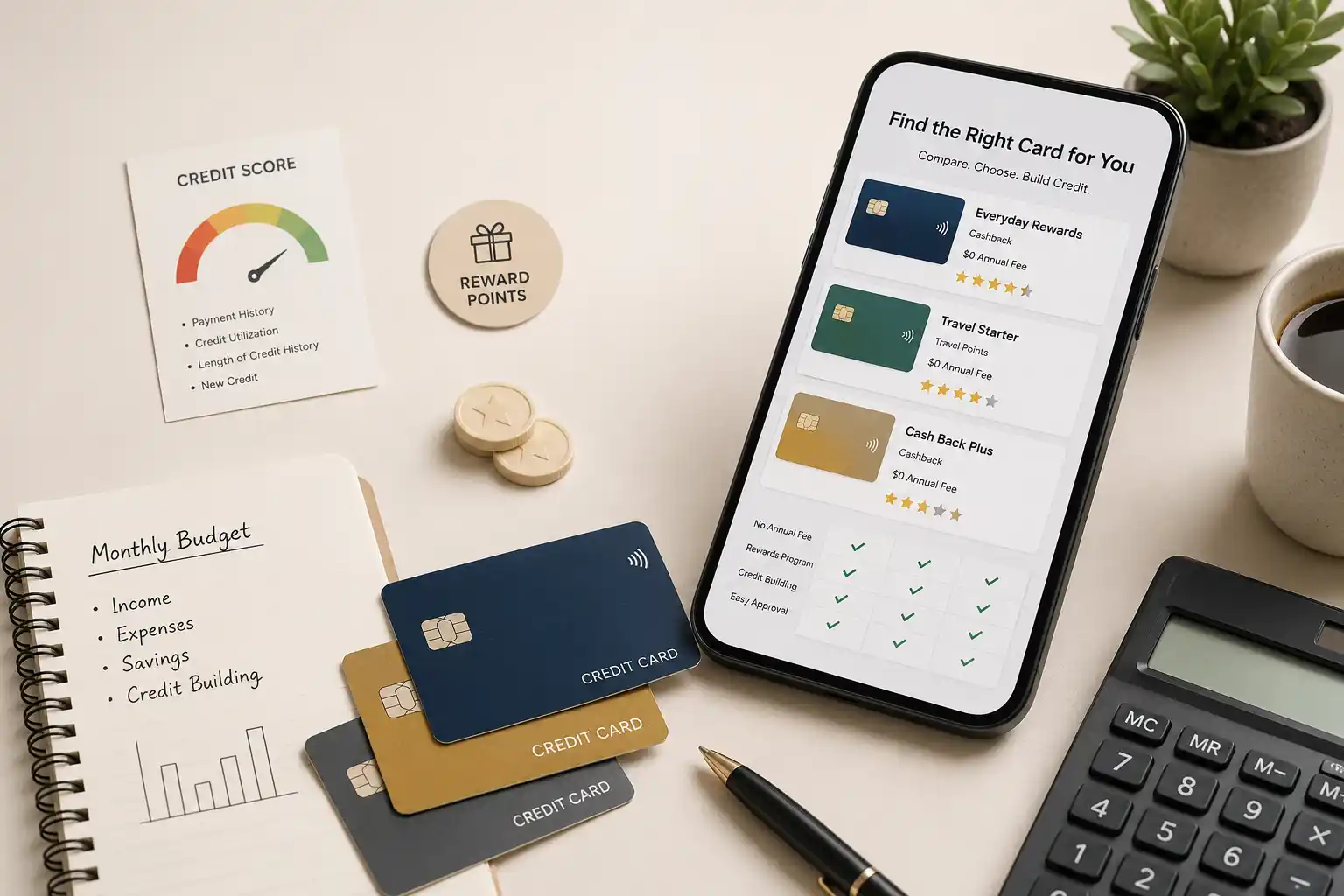
Opening a first credit card can feel more complicated than it should be. Between sign-up bonuses, reward categories, APR ranges, and a wall of unfamiliar terms, it’s easy to focus on the wrong things — like chasing the biggest bonus offer instead of asking whether a card actually fits your financial situation.
For beginners, the right first credit card usually isn’t the one with the flashiest promotion. It’s the one with manageable fees, a reasonable approval likelihood for your credit profile, and terms simple enough to understand and use responsibly. This guide walks through how credit cards work, what separates a beginner-friendly card from a complicated one, and how to compare your options so you can make a confident, informed decision — without needing a finance degree to do it.
1. What Is a Credit Card?
A credit card is a line of credit issued by a bank or credit union that lets you borrow money, up to a set limit, to make purchases. Unlike a debit card, which pulls money directly from your bank account, a credit card is a short-term loan that you’re expected to repay.
A few core terms come up constantly, so it helps to understand them upfront:
- Credit limit — the maximum amount you’re allowed to borrow on the card.
- Available credit — how much of your credit limit you haven’t used yet.
- Current balance — the total amount you currently owe, including any unpaid charges.
- Statement balance — the balance at the end of your billing cycle, which is the amount typically used to determine your payment due.
- Minimum payment — the smallest amount you’re required to pay by the due date to keep the account in good standing.
- Due date — the date your payment must be received to avoid late fees and potential penalties.
- APR (Annual Percentage Rate) — the yearly interest rate charged on balances that aren’t paid in full.
- Interest charges — the cost of carrying a balance past the due date or grace period.
- Credit utilization — the percentage of your available credit that you’re currently using; a major factor in credit scoring.
- Credit reporting — the process by which card issuers share your account activity with credit bureaus, which is how your credit history is built.
The biggest difference between a credit card and spending directly from a bank account is that a credit card involves borrowed money. Spending from a debit card or checking account uses funds you already have. Spending on a credit card creates a debt that must be repaid, and how you repay it directly affects your credit history.
2. How Do Credit Cards Work?
Every credit card follows a similar monthly cycle:
- You make purchases using the card, up to your available credit.
- Charges appear on your account in near real time as transactions post.
- A statement is generated at the end of your billing cycle, summarizing all charges, payments, and the resulting statement balance.
- The statement balance becomes due, typically about three weeks after the statement closes.
- You pay by the due date — ideally the full statement balance, though a minimum payment is usually accepted.
- Interest may apply if you carry a balance past the due date, depending on the card’s terms and whether it offers a grace period on new purchases.
The single most important habit for a beginner to build is paying the statement balance in full whenever financially possible. Doing so avoids interest charges entirely on most cards, since many issuers offer a grace period that waives interest on purchases if the previous balance was paid off completely.
3. What Makes a Credit Card Good for Beginners?
Not every credit card is designed with new users in mind. The most beginner-friendly cards tend to share several traits:
- No or low annual fee, so the card doesn’t cost money just to hold.
- Reasonable credit requirements that match a limited or developing credit history.
- A simple rewards structure that’s easy to understand and redeem.
- Low fees overall, including manageable late fees and no unnecessary add-ons.
- Useful fraud protections, such as zero-liability policies and transaction alerts.
- Free access to account management tools, including a mobile app and free credit score monitoring.
- Clear, readable terms rather than dense fine print full of exceptions.
- Reporting to major credit bureaus, since a card that doesn’t report won’t help build credit history.
- A reasonable APR, which matters most if there’s any chance a balance will occasionally be carried.
A card with a simple, flat-rate cash back program can be a better fit for a beginner than a complex premium travel card offering tiered points, transfer partners, and category rotations. Complexity isn’t a downside for an experienced cardholder who wants to maximize value, but for someone still learning the fundamentals, simplicity reduces the chance of costly mistakes.
4. Types of Credit Cards Beginners Can Consider
Starter Credit Cards
Starter cards are designed specifically for people with limited or no credit history. They tend to have modest credit limits, straightforward terms, and more accessible approval criteria than cards aimed at established borrowers.
Secured Credit Cards
A secured credit card requires a refundable security deposit, which typically becomes your credit limit (for example, a $200 deposit generally sets a $200 limit). Because the deposit reduces the issuer’s risk, secured cards are often easier to qualify for. Many secured cards report to the major credit bureaus, so responsible use — on-time payments and low utilization — may help establish a positive credit history over time. It’s worth confirming bureau reporting before applying.
Student Credit Cards
Student cards are typically available to college students with little or no income history, sometimes with proof of enrollment. They often include beginner-friendly features like no annual fee, straightforward rewards on categories like dining or groceries, and educational tools geared toward first-time users.
Cash Back Credit Cards
Cash back cards return a percentage of your spending, either as a flat rate on all purchases or a higher rate in specific categories like groceries, gas, or dining. Flat-rate cash back is generally the simplest option for a beginner because there’s nothing to track or optimize.
Travel Rewards Cards
Travel cards can offer significant value for frequent travelers, but they tend to involve more complexity — point valuations, transfer partners, blackout considerations, and sometimes higher annual fees. For a true beginner without an established credit history, a travel card may be harder to qualify for and harder to use optimally. They can still make sense for beginners who travel often and are comfortable learning the redemption details.
Low Interest Credit Cards
For anyone who anticipates occasionally carrying a balance, the ongoing APR matters more than any rewards program. A lower APR reduces the cost of carrying debt, though the healthiest long-term strategy is still to pay the statement balance in full whenever possible.
5. Best Credit Cards for Beginners: Comparison Framework
Card offers, APR ranges, and rewards structures change frequently, so specific current cards and rates should always be verified directly on the issuer’s official page before applying. The table below is an illustrative framework — not a list of currently verified offers — showing how to structure a side-by-side comparison once you’ve gathered real, up-to-date details.
| Card | Annual Fee | Rewards | APR | Credit Profile | Best For |
|---|---|---|---|---|---|
| Card A (illustrative) | $0 | Flat-rate cash back | Variable range | Fair/Good | Everyday spending |
| Card B (illustrative) | $0 (secured, deposit required) | Flat-rate or none | Variable range | Limited/No credit | Building credit |
| Card C (illustrative) | $0 | Category-based cash back | Variable range | Good | Cash back optimization |
| Card D (illustrative) | Annual fee applies | Travel points/miles | Variable range | Good/Excellent | Travel rewards |
When you build your own comparison, pull the annual fee, current APR range, rewards structure, and credit profile guidance directly from each issuer’s website, since these terms are updated regularly.
6. What Credit Score Do You Need for a Beginner Credit Card?
Approval for a credit card depends on far more than a single credit score number. Issuers generally evaluate:
- Credit history — how long you’ve had credit accounts and how they’ve been managed.
- Income — your ability to repay what you borrow.
- Existing debt — how much you already owe relative to your income.
- Payment history — whether past accounts (credit or otherwise) were paid on time.
- Credit utilization — how much of your existing credit you’re using.
- Application history — how many new accounts or credit inquiries you’ve had recently.
- Issuer underwriting — each bank sets its own internal approval criteria, which isn’t fully public.
Broadly, credit is often grouped into categories — no credit history, limited credit, fair credit, good credit, and excellent credit — but these categories are general guidelines, not guarantees. Two applicants with similar scores can receive different decisions from the same issuer depending on income, existing debt, and other factors. Always treat any “typical credit range” listed on a card’s application page as a guideline rather than a promise of approval.
7. Best Credit Cards for People With No Credit History
Beginners with no credit history at all have several starting points to consider:
- Secured credit cards — often the most accessible option, since the security deposit reduces the issuer’s risk.
- Student credit cards — a strong option for enrolled students, sometimes with more flexible approval criteria.
- Starter/unsecured cards for limited credit — some issuers offer entry-level unsecured cards designed for this exact situation.
- Authorized user arrangements — being added as an authorized user on a trusted person’s existing card (such as a parent’s) can, in some cases, help establish credit history, since the primary account’s history may appear on the authorized user’s credit report.
Each option has trade-offs. Secured cards require upfront cash. Student cards require enrollment. Authorized user arrangements depend entirely on someone else’s account being managed responsibly. Not everyone with no credit history needs to start with a secured card — the right starting point depends on individual circumstances like income, education status, and access to a creditworthy co-applicant or authorized-user relationship.
8. Best Credit Cards for Building Credit
When the primary goal is building credit, beginners should prioritize:
- Reporting to major credit bureaus — a card that doesn’t report won’t help your credit history at all.
- Low or no annual fees — since the card itself shouldn’t add financial strain.
- Manageable credit limits — a smaller limit can make it easier to keep utilization low.
- Automatic payment options — to avoid missed payments, which are the single most damaging factor to credit scores.
- Spending controls or alerts — many issuer apps offer tools to track spending in real time.
- Responsible utilization — generally keeping usage well below the credit limit.
It’s important to understand that simply owning a credit card does not automatically build good credit. Credit is built through consistent, responsible behavior over time — on-time payments and manageable utilization — not by the mere presence of an open account. For a deeper breakdown of the factors that move your score over time, see our related guide, How to Improve Your Credit Score.
9. How to Compare Credit Card APR
APR (Annual Percentage Rate) represents the yearly cost of borrowing if you carry a balance. Several types can appear on the same card:
- Purchase APR — the rate applied to everyday purchases if a balance is carried.
- Introductory APR — a temporary promotional rate, often 0%, that applies for a limited period before reverting to the standard rate.
- Variable APR — a rate that can move up or down over time, typically tied to a benchmark interest rate.
- Balance transfer APR — the rate applied to balances moved from another card.
- Cash advance APR — often the highest rate on the card, applied to cash withdrawals.
- Penalty or default APR — a higher rate that may apply after a missed or late payment, where applicable.
APR matters far less for someone who consistently pays the statement balance in full each month, since interest generally isn’t charged during a grace period on new purchases. For anyone who expects to occasionally carry a balance, APR becomes one of the most important factors in choosing a card. It’s worth noting that carrying a balance purely to try to “build credit faster” doesn’t work that way — responsible utilization and on-time payments build credit, not interest payments.
10. Credit Card Fees Beginners Should Understand
| Fee | What It Means | What Beginners Should Watch For |
|---|---|---|
| Annual Fee | Yearly cost of holding the card | Prefer $0 unless the benefits clearly justify the cost |
| Late Payment Fee | Charged after missing a required payment | Avoid with autopay or payment reminders |
| Foreign Transaction Fee | Fee applied to eligible purchases made abroad | Important if you travel internationally |
| Cash Advance Fee | Cost of borrowing cash against your credit line | Usually expensive; best avoided |
| Balance Transfer Fee | Fee for moving a balance from another card | Compare against potential interest savings |
| Returned Payment Fee | May apply if a payment fails to process | Keep your linked payment account funded |
Fees and their exact amounts vary by card and issuer, so always confirm current fee schedules on the issuer’s official terms page.
11. Sign-Up Bonuses: Are They Worth It?
Sign-up bonuses can add real value, but they come with conditions worth understanding first:
- Minimum spending requirements — most bonuses require spending a set amount within a limited window (often 3 months).
- Bonus eligibility — some issuers restrict bonuses for applicants who’ve held the same card before.
- Limited-time offers — bonus amounts and requirements change frequently.
- Exclusions — certain transactions (like cash advances or balance transfers) typically don’t count toward the spending requirement.
- Annual fee considerations — a bonus tied to a card with a high annual fee may not offset the ongoing cost.
- Opportunity cost — chasing a bonus with a card that’s a poor overall fit can outweigh the one-time reward.
Beginners should never spend extra money they wouldn’t otherwise spend just to hit a bonus threshold. A bonus is only valuable if it’s earned through spending you’d already be doing.
12. Cash Back vs. Travel Rewards
| Feature | Cash Back | Travel Rewards |
|---|---|---|
| Simplicity | Usually high | Often lower |
| Redemption | Generally simple (statement credit, direct deposit) | Can be more complex (transfer partners, point valuations) |
| Best For | Everyday spending | Frequent travelers |
| Value | Easier to understand and calculate | Can vary significantly by redemption method |
| Beginner Friendly | Usually yes | Depends on the specific program |
The right reward type depends entirely on actual spending habits and lifestyle. A beginner who rarely travels will typically get more consistent value from a cash back card, while a beginner who travels frequently and is willing to learn a program’s redemption rules may find a travel card worthwhile.
13. Secured vs. Unsecured Credit Cards
| Feature | Secured Card | Unsecured Card |
|---|---|---|
| Security Deposit | Usually required | Usually not required |
| Credit Limit | Often tied to the deposit amount | Set by the issuer based on creditworthiness |
| Credit Building | Can report to bureaus | Can report to bureaus |
| Approval | Often more accessible | Depends on credit profile |
| Best For | Limited or no credit history | Established or improving credit |
Before applying for a secured card, confirm directly with the issuer that it reports account activity to the major credit bureaus — this is what makes the card useful for credit building. Not all secured products are structured the same way.
14. How to Choose Your First Credit Card
- Check your current credit profile, if you have one.
- Determine whether you have established credit history or are starting from scratch.
- Decide whether your primary goal is cash back, a low APR, or credit building.
- Compare annual fees across your options.
- Compare APR ranges, especially if you might carry a balance.
- Review the rewards structure for simplicity and relevance to your spending.
- Check foreign transaction fees if you travel internationally.
- Review the card’s stated eligibility or credit profile guidance.
- Read the full terms and conditions before applying.
- Apply selectively — submitting multiple applications at once can affect your credit profile.
15. How Many Credit Cards Should a Beginner Have?
There’s no universal “ideal” number of credit cards. The right number depends on:
- How easily you can manage multiple due dates and payments.
- How multiple accounts affect your overall credit utilization.
- Whether any of the cards carry annual fees that add up.
- How comfortable you are tracking account activity across cards.
- How established your credit history already is.
- Your general spending discipline.
Many beginners benefit from starting with a single card, using it responsibly for several months to a year, and only then considering whether a second card makes sense. Mastering one account first makes it easier to build good habits before adding complexity.
16. How to Use a Credit Card Responsibly
- Pay on time, every single month.
- Prefer paying the statement balance in full whenever possible.
- Keep credit utilization at a manageable level.
- Don’t spend more than you normally would just to earn rewards.
- Avoid cash advances unless absolutely necessary — they’re typically expensive.
- Monitor transactions regularly for errors or unauthorized charges.
- Set up payment due-date alerts or autopay.
- Review monthly statements closely.
- Never share your card’s security code or account credentials.
Rewards are only valuable when they don’t encourage unnecessary spending or lead to costly interest charges. A card that earns 2% cash back but leads to carrying a balance at a much higher APR isn’t actually a good deal.
17. How Credit Cards Affect Your Credit Score
Several factors tied to credit card use influence your credit score over time:
- Payment history — generally the most heavily weighted factor; missed payments can be very damaging.
- Credit utilization — how much of your available credit you’re using.
- Length of credit history — how long your accounts have been open on average.
- New credit applications — opening a new account typically triggers a hard inquiry, which can cause a small, temporary dip.
- Credit mix — having different types of credit (revolving and installment) can be a minor positive factor.
Opening a new card can affect your average account age and result in a hard inquiry, but responsible use over time — on-time payments and healthy utilization — can help establish a positive credit history. No card or strategy can promise a specific score increase, since scoring models weigh many factors simultaneously and outcomes vary by individual.
18. Common Credit Card Mistakes Beginners Make
- Applying for too many cards at once.
- Missing payments, even occasionally.
- Paying only the minimum indefinitely, which maximizes interest costs.
- Chasing rewards instead of choosing the right overall card.
- Ignoring annual fees that quietly outweigh rewards earned.
- Ignoring APR until a balance is already accumulating interest.
- Relying on cash advances, which carry high fees and APRs.
- Maxing out the card, which sharply increases utilization.
- Closing accounts without understanding the potential effect on credit history length and utilization.
- Spending beyond what was planned simply because credit is available.
- Ignoring or failing to report fraudulent transactions promptly.
19. How to Build Credit With Your First Credit Card
A practical timeline for a first-time cardholder might look like this:
Month 1
Activate the card, set up online account access, and establish a secure, reliable way to make payments — ideally autopay for at least the minimum payment as a safety net.
Months 2–3
Make small, manageable purchases you already budgeted for, and pay the statement balance on time each cycle.
Months 4–6
Monitor your credit utilization and check your credit reports for accuracy, since errors can occasionally appear.
Months 7–12
Evaluate whether the card still fits your financial needs — whether the rewards, limit, and terms still make sense, or whether it’s time to consider a second card or a product upgrade.
Building credit isn’t a one-time action; it requires continued, consistent, responsible behavior well beyond the first year.
20. Credit Card Features Beginners Should Avoid
- High annual fees without a clear, calculable benefit.
- Overly complicated rewards programs that are hard to actually use.
- High cash advance costs.
- Excessive foreign transaction fees if you travel internationally.
- Promotional terms that are difficult to understand or that hide what happens after the promotional period ends.
- Fee structures that quietly erode the value of any rewards earned.
- Products with unclear or unconfirmed credit bureau reporting practices.
21. Questions to Ask Before Applying
☐ What is the annual fee? ☐ What is the regular purchase APR? ☐ Is there an introductory APR, and for how long? ☐ What happens to the rate after the promotional period ends? ☐ What are the rewards, and how are they earned? ☐ Are there minimum spending requirements for a bonus? ☐ Are rewards capped at a certain spending level? ☐ Are there foreign transaction fees? ☐ Does the card report to the major credit bureaus? ☐ What credit profile does the issuer typically look for? ☐ What are the late payment fees? ☐ Can the credit limit increase over time, and how?
22. Best Beginner Credit Card by Financial Goal
| Goal | Card Type to Consider | What to Prioritize |
|---|---|---|
| Build credit from scratch | Secured or starter card | Credit bureau reporting, low fees |
| Simple, predictable rewards | Flat-rate cash back card | Ease of redemption |
| Grocery and everyday spending | Category-based cash back card | Relevant bonus categories |
| Frequent travel | Travel rewards card | Rewards flexibility and travel benefits |
| Occasionally carrying a balance | Lower APR card | Total interest cost |
| Student spending | Student credit card | Low fees, simple rewards |
These are general card categories to guide research, not specific product recommendations — the right choice still depends on your individual credit profile and goals.
Internal Links:
- How to Improve Your Credit Score
- How to Pay Off Credit Card Debt
- How Credit Scores Work
- Best Ways to Save Money Every Month
- How to Create a Monthly Budget
- Best Online Banking Options for Beginners
- Best Personal Finance Apps
- Term Life Insurance Guide for Beginners
EWC Chess 2026 Results, Winner, Standings & Prize Money
Frequently Asked Questions
What is the best credit card for a beginner?
There’s no single best card for every beginner. The right choice depends on your credit profile, whether you want cash back or credit-building features, and how comfortable you are with fees and APR. Generally, a no-annual-fee card with straightforward rewards and bureau reporting is a strong starting point.
What credit card is easiest to get for a first-time user?
Secured credit cards and student credit cards are typically among the more accessible options for first-time applicants, since they’re specifically designed for limited or no credit history.
What credit score do I need for a beginner credit card?
It varies by issuer and card. Some starter and secured cards are designed for no or limited credit history, while others require fair or good credit. Approval also depends on income and existing debt, not score alone.
Is a secured credit card good for beginners?
Secured cards can be a good starting point for building credit, especially for those with no credit history, as long as the card reports to major credit bureaus and the deposit amount is affordable.
Should my first credit card have an annual fee?
Generally, no. A $0 annual fee card is usually preferable for beginners unless a fee-based card offers clear, quantifiable benefits that outweigh its cost.
Is cash back or travel rewards better for beginners?
Cash back is typically simpler and easier for beginners to understand and redeem. Travel rewards can offer more value for frequent travelers willing to learn a program’s redemption rules.
How much should I spend on my first credit card?
Only spend what you would spend anyway and can comfortably pay off. Using the card for planned, budgeted purchases is safer than spending extra to chase rewards.
Should I pay my credit card balance in full every month?
Whenever financially possible, yes. Paying the statement balance in full avoids interest charges and supports healthy credit utilization.
Does having a credit card improve your credit score?
Not by itself. A credit card can help build credit history over time, but only when used responsibly — on-time payments and manageable utilization are what actually influence your score.
How many credit cards should a beginner have?
There’s no universal number. Many beginners benefit from starting with one card and mastering responsible use before considering additional accounts.
Can I get a credit card with no credit history?
Yes. Secured cards, student cards, and some starter cards are designed for applicants with no prior credit history, though approval still depends on the issuer’s broader criteria.
What is the best first credit card for building credit?
Look for a card that reports to the major credit bureaus, carries low or no fees, and has terms you fully understand — whether that’s a secured card, a student card, or a starter unsecured card depends on your individual situation.
The best beginner credit card isn’t determined by the size of a sign-up bonus or a flashy rewards program. It’s the card that fits your credit profile, comes with manageable fees, matches your actual spending habits, has terms you genuinely understand, and — most importantly — one you can commit to using responsibly.
For most beginners, that means prioritizing a $0 annual fee, confirmed credit bureau reporting, a straightforward rewards structure (if any), and a realistic sense of your own approval odds before applying. Responsible use over time — on-time payments and manageable utilization — will always matter more to your credit and finances than any single reward or promotional offer.
2 thoughts on “Best Credit Cards for Beginners”