
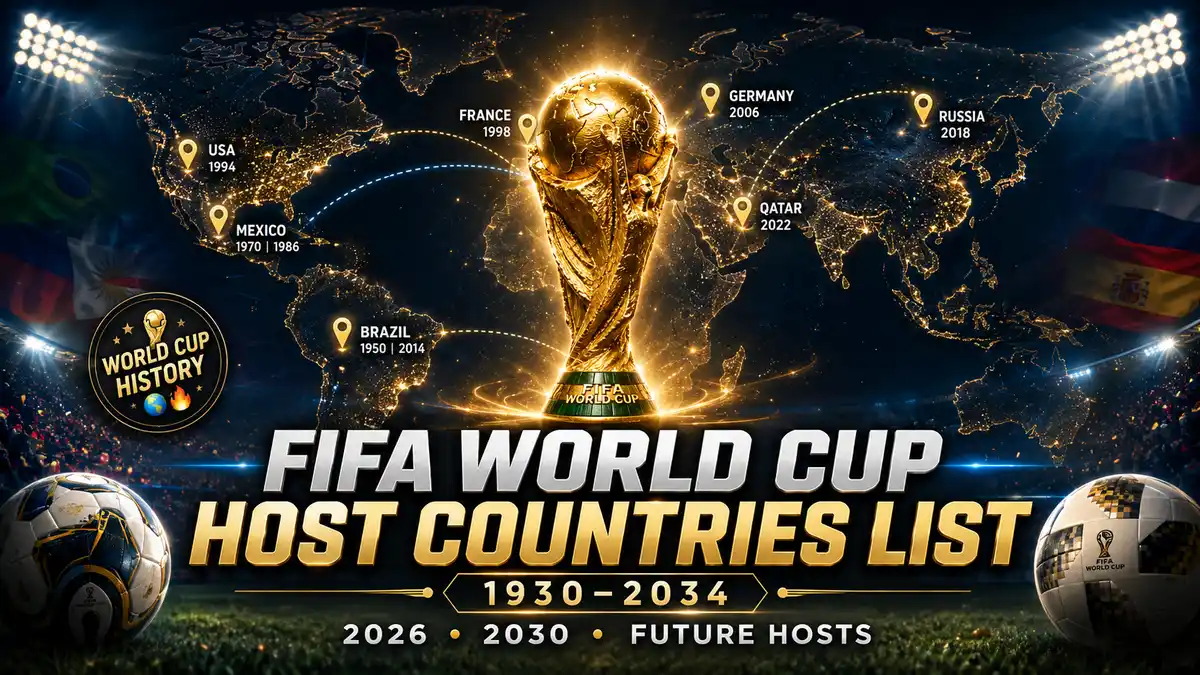
The FIFA World Cup is the planet’s biggest sporting event, captivating billions every four years. From humble beginnings in Uruguay to massive multi-nation tournaments, the choice of host country shapes the tournament’s legacy, culture, and global reach.
Whether you’re curious about the 2026 World Cup hosts, World Cup 2030 host country, or speculating on the World Cup 2042 host, this guide covers the full history and what lies ahead.
A Brief History of World Cup Hosting
The first FIFA World Cup took place in 1930. FIFA awarded it to Uruguay to celebrate the country’s centenary of independence. Only 13 teams participated, mostly from South America and Europe.
Hosting rights have rotated across continents, with Europe and South America dominating early editions. Multiple hosts became common starting in 2002 (Japan and South Korea). The trend toward co-hosting reflects larger tournament sizes and efforts to share infrastructure costs and fan experiences.
Notable repeats: Mexico, Italy, France, Germany, and Brazil have each hosted twice.
Complete List of Past FIFA World Cup Hosts
Here’s every host nation since the tournament began:
| Year | Host Nation(s) | Continent | Notes |
|---|---|---|---|
| 1930 | Uruguay | South America | First FIFA World Cup |
| 1934 | Italy | Europe | – |
| 1938 | France | Europe | – |
| 1942 | — | — | ❌ Canceled due to World War II |
| 1946 | — | — | ❌ Canceled due to World War II |
| 1950 | Brazil | South America | Tournament resumed |
| 1954 | Switzerland | Europe | – |
| 1958 | Sweden | Europe | – |
| 1962 | Chile | South America | – |
| 1966 | England | Europe | – |
| 1970 | Mexico | North America | First World Cup in North America |
| 1974 | West Germany | Europe | Now Germany |
| 1978 | Argentina | South America | – |
| 1982 | Spain | Europe | – |
| 1986 | Mexico | North America | First nation to host twice |
| 1990 | Italy | Europe | Second time |
| 1994 | United States | North America | First hosted in the U.S. |
| 1998 | France | Europe | Second time |
| 2002 | Japan & South Korea | Asia | First co-hosted FIFA World Cup |
| 2006 | Germany | Europe | Unified Germany |
| 2010 | South Africa | Africa | First FIFA World Cup in Africa |
| 2014 | Brazil | South America | Second time |
| 2018 | Russia | Europe | – |
| 2022 | Qatar | Asia | First FIFA World Cup in the Middle East |
| 2026 | Canada, Mexico & United States | North America | First FIFA World Cup hosted by three nations; Mexico becomes the first country to host the men’s FIFA World Cup three times. |
The 1942 and 1946 tournaments were canceled due to World War II.
2014 FIFA World Cup Host Country
Brazil hosted the 2014 edition. It was the country’s second time (after 1950). Iconic venues like the Maracanã in Rio de Janeiro hosted the final. The tournament featured high-scoring games and passionate crowds but also faced criticism over infrastructure costs and protests. Germany won the title, defeating Argentina 1-0 in extra time in the final.
2026 World Cup Hosts
The 2026 FIFA World Cup will be the first hosted by three countries: Canada, Mexico, and the United States. It expands to 48 teams and features 104 matches across 16 cities (11 in the US, 3 in Mexico, 2 in Canada).
This North American collaboration maximizes existing stadiums and infrastructure. The final will be held at MetLife Stadium in New York/New Jersey. It marks a significant milestone in expanding the tournament’s global footprint.
2030 FIFA World Cup Host Country
The 2030 World Cup celebrates the tournament’s centenary. Morocco, Portugal, and Spain will serve as the main hosts. Three opening celebration matches will take place in South America: one each in Uruguay, Argentina, and Paraguay.
This unique format spans continents and honors the 1930 origins while leveraging modern European and African infrastructure. It will be the first tournament crossing the Mediterranean.
2034 World Cup Host
Saudi Arabia will host the 2034 FIFA World Cup. It was confirmed by acclamation in December 2024. As the second Middle Eastern host after Qatar 2022, Saudi Arabia plans an ambitious event with modern venues and a focus on legacy projects. It will be the first 48-team tournament hosted by a single country.
World Cup Hosts List: Trends and Rotation
FIFA aims for continental rotation to give different regions opportunities. Key patterns include:
- Europe and South America have hosted the most.
- Asia and the Middle East gained prominence with 2002, 2022, and 2034.
- Africa first hosted in 2010.
- North America returns strongly in 2026.
Co-hosting reduces financial burden on single nations and increases accessibility.
Future Hosts: 2038, 2042, and Beyond
No official hosts have been selected yet for 2038 or 2042. Bidding processes typically start years in advance.
Germany has expressed interest in bidding for 2038 or 2042, potentially marking a third hosting. Other speculated contenders include joint bids from various European or South American nations, though FIFA’s rotation policies will influence outcomes.
The World Cup 2042 host country remains open, with ongoing discussions about sustainable hosting models for the expanded format.
Why FIFA World Cup Host Selection Matters
Hosting the FIFA World Cup is about far more than staging football matches. It is one of the world’s biggest sporting events, capable of transforming a country’s economy, infrastructure, global reputation, and sporting legacy for decades.
Economic Growth and Tourism
A World Cup attracts millions of international visitors, generating billions of dollars through tourism, hospitality, transportation, retail, and entertainment. Hotels, restaurants, airlines, and local businesses often experience a significant boost in revenue, while the host nation gains worldwide exposure that can increase future tourism.
Infrastructure Development
Preparing for the tournament usually requires major investments in stadiums, airports, roads, rail networks, public transportation, telecommunications, and urban development. These improvements can leave a lasting legacy if they continue to benefit residents after the tournament ends.
Global Recognition and National Image
The FIFA World Cup offers host countries an opportunity to showcase their culture, history, technology, and hospitality to billions of viewers worldwide. A successful tournament can strengthen a nation’s international reputation, attract foreign investment, and promote its tourism industry for years.
Challenges and Financial Risks
Hosting the World Cup also presents significant challenges. Building stadiums and infrastructure often requires substantial public spending, and some venues may become underused after the tournament. Organizers must also manage security, transportation, accommodation, and environmental concerns while ensuring the event remains financially sustainable.
Sustainability, Human Rights, and Legacy
In recent years, FIFA has placed greater emphasis on sustainability, environmental responsibility, human rights, worker welfare, and long-term legacy planning during the host selection process. Candidate countries are expected to demonstrate how the tournament will deliver lasting social and economic benefits while minimizing environmental impacts and protecting local communities.
The Future of World Cup Hosting
The successful joint hosting of the 2026 FIFA World Cup by Canada, Mexico, and the United States marks a new era for the tournament. Multi-country hosting allows nations to share costs, utilize existing infrastructure, reduce financial risks, and bring football to a wider audience, making collaborative bids increasingly attractive for future FIFA World Cups.
What Makes a Great FIFA World Cup Host?
Hosting the FIFA World Cup requires much more than building stadiums. A successful host nation must deliver a world-class tournament while creating a lasting legacy for its people, football, and economy.
Modern Stadiums and Reliable Infrastructure
A top World Cup host offers FIFA-standard stadiums, efficient airports, modern public transportation, quality hotels, and advanced communication networks. These facilities ensure smooth travel for players, officials, media, and millions of supporters throughout the tournament.
Passion for Football
Countries with a strong football culture create an unforgettable atmosphere. Passionate fans, vibrant local traditions, and packed stadiums help transform the World Cup into a global celebration rather than just a sporting event.
Capacity to Welcome International Fans
The tournament attracts hundreds of thousands of visitors from around the world. Successful hosts must provide sufficient accommodation, reliable transportation, healthcare services, security, and tourist-friendly facilities to ensure a safe and enjoyable experience for everyone.
Political and Economic Stability
Organizing the FIFA World Cup is a massive logistical challenge that requires stable governance, sound financial planning, and effective coordination between governments, local authorities, and FIFA. Political and economic stability helps ensure projects are completed on time and major events run smoothly.
Sustainability and Long-Term Legacy
Modern World Cup hosts are increasingly judged by what remains after the final whistle. FIFA now places greater emphasis on environmental sustainability, responsible infrastructure investment, community development, and the long-term use of stadiums and public facilities, ensuring the tournament benefits future generations rather than becoming a short-lived spectacle.
Every Host Leaves Its Mark
From Uruguay’s historic 1930 tournament, which launched the FIFA World Cup, to today’s multi-nation events featuring cutting-edge stadiums and advanced technology, every host nation has contributed a unique chapter to football history. Whether through unforgettable fan experiences, iconic venues, or cultural celebrations, each World Cup reflects the identity of its host while helping shape the evolution of the world’s biggest sporting event.
Read more: FIFA World Cup 2026 Tickets: Prices, Packages, Official Website & Booking Guide
- The Chess Olympiad Winners List: A Complete History of Global Chess Glory
- TOP PUBG Player: Age, Real Name, Height, Team, Stats, Net Worth & Career
- Champions League Fixtures 2026/27 Bangladesh Time: Full Schedule
- Premier League Fixtures 2026/27: Full Schedule in Bangladesh Time (BST, UTC+6)
- Best Online Banking for Beginners: How to Choose the Right Bank
FAQ Section
Who is hosting the 2026 World Cup?
Canada, Mexico, and the United States are co-hosting the 2026 FIFA World Cup.
Which country is hosting the 2030 World Cup?
Morocco, Portugal, and Spain are the main hosts, with centenary matches in Uruguay, Argentina, and Paraguay.
Who will host the 2034 FIFA World Cup?
Saudi Arabia will host the 2034 tournament.
Has any country hosted the World Cup more than once?
Yes—Mexico, Italy, France, Germany (as West Germany), and Brazil have each hosted twice.
What is the 2014 FIFA World Cup host country?
Brazil hosted the 2014 World Cup.
Will the World Cup continue with multiple hosts?
Yes, co-hosting is likely to remain common due to the 48-team format and sustainability goals. Future editions like 2038 and 2042 may follow similar models, though single-host bids are still possible.
Conclusion
From Uruguay in 1930 to Saudi Arabia in 2034, FIFA World Cup hosts reflect the sport’s global evolution. The upcoming tournaments in North America (2026), across Europe-Africa-South America (2030), and in Saudi Arabia (2034) promise exciting new chapters.
As bidding for 2038 and 2042 heats up, football fans worldwide will watch closely. Which country would you like to see host next? Share your thoughts and stay tuned for more updates on the beautiful game’s greatest stage.
1 thought on “FIFA World Cup Host Countries List (1930–2034) | 2026, 2030 & Future Hosts”